
18 NOV 2026 · 4 min read
The Digital Far West Is Here: A Call to Build Trust and Protect Our Common House
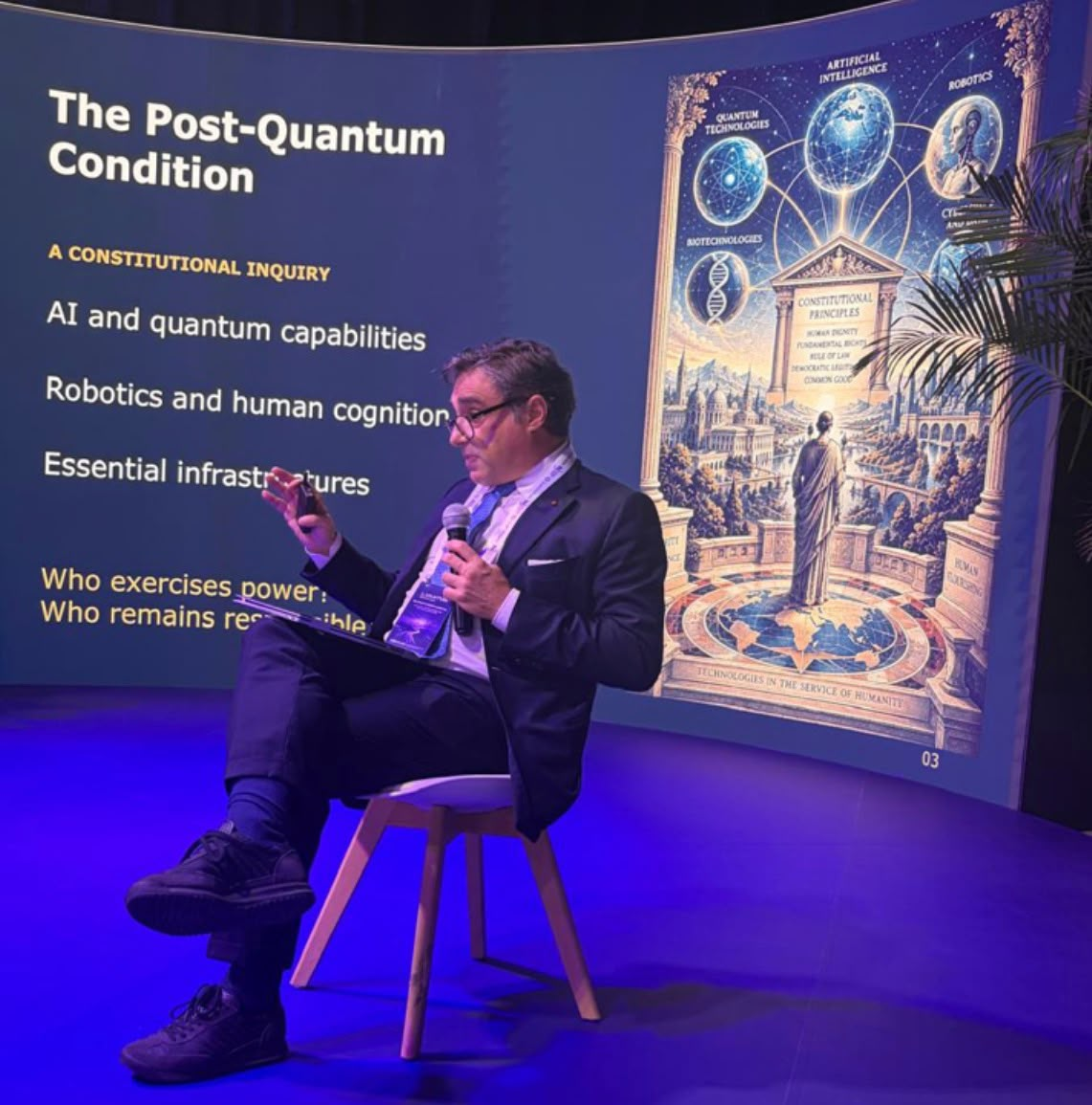
Spirit of Quantum: It Is Time to Come Together.
Cyberattacks and technical failures reveal how deeply we depend on one another. IASC’s call to protect infrastructure, cognitive liberty and our Common House.
By Prof. Gabriele Pao-Pei Andreoli
President, Institute for Advanced Studies and Cooperation (IASC)
When access to an account, a payment or a flight suddenly fails, digital dependence becomes tangible. In The Digital Far West, I warned that technological power was advancing faster than our capacity to govern it. Recent events make that concern impossible to dismiss.
This is why IASC, the Institute for Advanced Studies and Cooperation, is launching Spirit of Quantum: a cooperative platform to help institutions and communities protect human dignity as technologies converge.
On 17 November, Apple experienced disruptions affecting iCloud sign-ins, the App Store and other services; users also reported problems with Apple Pay. Apple subsequently attributed the outages to an internal update, ruled out a cyberattack and said many systems were operating again. That clarification matters: an outage must not automatically become evidence of sabotage. [1, 2]
The preceding days brought disruptions to Microsoft services, a nationwide US flight grounding and problems at JPMorgan Chase. Available explanations pointed to technical failures. These incidents reveal the consequences of dependence without establishing a common attacker. [3, 11]
Confirmed cyberattacks expose other weaknesses. On 16 November, Report URI identified malicious scripts associated with 178 organisations using Optimizely, including the BBC, CNN, Zoom, HSBC and IKEA. Code delivered through this supplier could steal payment information, substitute cryptocurrency addresses and target vulnerable iPhones and iPads. Optimizely said it had fixed the vulnerability and removed the injected code. [4, 5]
On 17 November, Equinor reported an attack against certain IT systems, while stating that production was unaffected and there was no indication of data theft. Maersk had separately confirmed unauthorised access and data extraction from an acquired legacy system, without anticipating operational disruption. [6, 7]
In France, La Poste confirmed that a September attack against Maileva exposed identification data concerning 22 million people. In Japan, RIKEN suspended Fugaku on 14 November after unauthorised access, warning of possible exposure of personal information concerning up to 4,597 Fugaku and RIKYU users. [8, 9]
Artificial intelligence adds another dimension. A 13 November FBI alert described malicious use of ARTEX, a framework using AI agents to automate stages of cyber intrusion. The same capacity to accelerate legitimate work can accelerate abuse. [10]
The connection concerns our dependencies. Organisations cannot protect every relationship by securing their own perimeter. Responsibility must extend across suppliers, inherited systems and borders. When services fail, citizens need to know who can restore them and answer for the harm. Communicating uncertainty honestly helps counter rumours and polarisation, preserving the cooperation needed to keep communities safe and essential services functioning.
In The Post-Quantum Constitution, the Babel Principle describes complexity outgrowing the ethical, constitutional and relational foundations needed to sustain trust. The Babel Condition emerges when communication continues while shared, reliable understanding deteriorates. We can exchange more information while becoming less capable of judging it together.
Constitutional Interoperability allows institutions with different legal traditions to cooperate through compatible guarantees. Trust by Design makes reliance verifiable through transparency, accountability and opportunities to challenge consequential decisions. The Common House Principle recognises duties towards shared foundations of life that no community can adequately protect alone. Human dignity is the foundation; human flourishing is the purpose.
Grounded in The Post-Quantum Constitution, Spirit of Quantum is being developed as an agentic platform connecting scholarly knowledge with practical guidance under human oversight. We invite governments, institutions, researchers, engineers, philosophers, theologians and leaders to help govern the convergence of artificial intelligence, quantum technologies, robotics and biotechnology.
Our work must produce tested recovery plans, clearer supplier responsibilities and cooperation across borders. Accountability for deliberate harm requires evidence and due process. Public education must protect cognitive liberty, strengthen judgment and resist manipulation without silencing legitimate disagreement. Individuals should install security updates and examine unexpected payment or account activity.
More than 140 flights this year have taken me into discussions about cybersecurity, quantum technologies and humanity’s future. This service has been exhausting, but beautiful. It has strengthened my commitment to antifragility: learning from disruption and developing greater capacity to protect one another.
IASC is a nonprofit humanitarian foundation. We need funding, expertise and committed partners to continue. Peace and regenerative science require communities capable of acting together. Science should restore the conditions for life, from human health to ecosystems. The Digital Far West is here. We must build the knowledge, institutions and relationships through which humanity can flourish.